
The Anatomy of a Perfect Minute: How Japan's Railways conquered Time
Japan’s railways have turned punctuality into a national discipline. Behind every perfectly timed arrival lies a culture built around precision, responsibility and respect for time.

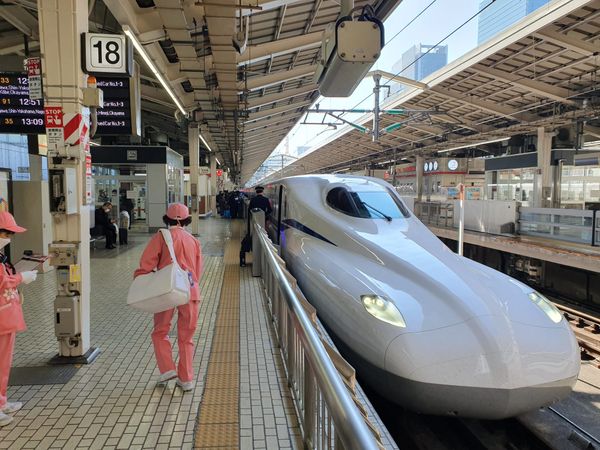
The discipline behind the timetable
In Japan, a train arriving on time is not considered an achievement. It is simply what is expected.
Across a railway network carrying millions of passengers every day, precision has become part of the national rhythm. Trains arrive, doors open, passengers move, and departures follow with a degree of accuracy that can seem almost impossible to visitors accustomed to delays elsewhere.
But Japan’s extraordinary railway punctuality is not the result of one clever technology or a particularly efficient timetable. It is the product of something much deeper: a culture of preparation, responsibility, repetition and respect for time.
The famous Shinkansen may be the most visible symbol of that philosophy, but the real story begins long before a train enters the station.
Precision begins with people
The technology behind Japan’s railways is impressive, but technology alone does not explain their extraordinary reliability. At the heart of the system are thousands of employees trained to treat small details as important.
Drivers, conductors and platform staff work according to carefully defined procedures. One of the most distinctive is pointing and calling — known in Japan as shisa kanko. Instead of merely looking at a signal, speed indicator or platform marker, the employee physically points towards it and calls out what they see.
To an outsider, the ritual can appear almost theatrical. Its purpose, however, is serious: turning a routine mental check into a physical and verbal action makes mistakes harder to overlook.
On a railway where seconds matter, attention is not left to chance.
The birth of the bullet train
When the Tokaido Shinkansen began operating between Tokyo and Osaka in 1964, it changed expectations of what a railway could be. Japan had created not simply a faster train, but an entirely new high-speed railway system.
The timing was symbolic. Tokyo was hosting the 1964 Olympic Games, and the Shinkansen became a powerful demonstration of a country transforming itself through engineering, organisation and ambition.
Its distinctive streamlined trains quickly became internationally recognised as the bullet train.
But speed was only part of the achievement.
The greater revolution was reliability. By separating high-speed trains from slower conventional traffic and designing tracks, signalling, stations and operating procedures around one integrated system, Japan created an environment in which precision could be engineered into everyday operation.
More than six decades later, that original idea still defines the Shinkansen: speed attracts attention, but consistency earns trust.
When a delay becomes an event
In many countries, passengers barely react when a train arrives several minutes late. In Japan, even a small delay is treated seriously.
Railway companies closely examine disruptions because punctuality is not viewed merely as a statistic. It is part of the promise made to the passenger.
When delays occur, station staff provide frequent information and apologies. In some circumstances, railway operators can even issue passengers with a delay certificate — documentation that can be shown to an employer or school to explain why they arrived late.
That small detail reveals something important about Japanese railway culture.
Time is treated as something belonging not only to the railway, but to the passenger.
A minute lost by one train may seem insignificant. Multiply it by hundreds or thousands of passengers, however, and that minute suddenly carries a very different weight.
And that is perhaps one of the secrets behind the system: punctuality is ultimately a form of respect.
The seven-minute miracle
At Tokyo Station, one of the most remarkable demonstrations of Japan’s railway culture happens while the train is standing still.
When a Shinkansen reaches the end of its journey, cleaning crews wait beside the platform. Once the passengers have left, the teams enter and begin a carefully rehearsed routine.
Seats are turned to face the direction of travel. Tables are wiped, floors and luggage areas are checked, rubbish is removed, blinds are adjusted and the carriage is prepared for the next passengers — all within an extraordinarily short turnaround.
The operation became famous internationally as the “seven-minute miracle.”
Yet the impressive part is not simply the speed.
Watch the teams at work and there is little sense of panic. Every person knows where to go, what to check and when to move. The process resembles choreography more than hurried cleaning.
When the work is finished, the crew lines up on the platform and bows towards the departing passengers.
It is a small ceremony, but it captures something larger about the Japanese approach to service:
Efficiency does not have to come at the expense of dignity.
A railway built around the passenger
Japanese punctuality is often explained as an engineering achievement. But engineering is only half the story.
The railway is designed around the assumption that passengers themselves are part of the system.
On busy platforms, markings indicate where doors will stop. Passengers form orderly queues before the train arrives. Boarding and leaving happen quickly because people generally understand the rhythm expected of them.
Stations that at first appear overwhelmingly complex reveal another characteristic: information is everywhere. Signs, platform numbers, coloured lines, announcements and precise stopping positions quietly guide enormous numbers of people through the network.
This cooperation between railway staff and passengers allows something extraordinary to happen every day: millions of individual journeys become part of one coordinated movement.
There is an important lesson hidden inside that apparent simplicity.
Japan did not conquer time by trying to make everyone move faster.
It did so by removing the small uncertainties that make everyone slower.
What happens when something goes wrong
Precision does not mean that Japan’s railways never experience disruption. Severe weather, earthquakes, technical problems and emergencies can still bring trains to a halt.
The difference lies in how disruption is treated.
Railway operators work with detailed procedures for identifying problems, communicating with passengers and restoring normal service. On the Shinkansen network, sophisticated monitoring systems also play an important role in responding to risks such as earthquakes.
But there is another principle at work: a delay is something to learn from.
When operations fail to perform as expected, the objective is not simply to get the timetable moving again. Understanding why something happened — and how the same problem might be prevented in the future — is part of maintaining the system’s extraordinary consistency.
That attitude turns punctuality into something more than keeping time.
It becomes a culture of continuous improvement.
The value of a minute
Why does any of this matter?
Because punctuality is not really about trains.
It is about standards.
A railway that consistently arrives when it says it will creates trust. A passenger can arrange a meeting, make a connection or plan a journey knowing that the timetable means something.
That trust is built through thousands of details most passengers will never notice: the driver checking an instrument, the platform attendant confirming a departure, the engineer inspecting a component, the cleaner preparing a carriage for its next journey.
None of these actions alone explains Japan’s railway system.
Together, they create something much more difficult to achieve: consistency at enormous scale.
Perhaps that is why the Japanese railway story fascinates the rest of the world. It demonstrates that excellence rarely comes from one spectacular gesture.
More often, it comes from doing ordinary things extraordinarily well — again and again, every single day.
Conquering time
Japan’s railways did not conquer time by defeating it.
They did something far more practical: they learned to respect it.
From the driver pointing at a signal to the cleaning crew preparing a carriage, from the engineer maintaining the track to the passenger waiting in the correct place on the platform, the system depends upon thousands of people accepting responsibility for their small part of a much larger whole.
The result is a railway culture admired around the world — not simply because its trains are fast, but because passengers have learned to trust them.
There may also be a lesson here far beyond the railway platform.
In an age when speed is often confused with efficiency, Japan’s railways demonstrate that true efficiency comes from preparation, discipline and consistency.
Perhaps the perfect minute does not exist because nothing ever goes wrong.
Perhaps it exists because everyone understands that every minute matters.
— The Butler
Written by